
Understand
Know AI.Understand AI's capabilities, limitations, risks, and appropriate uses.
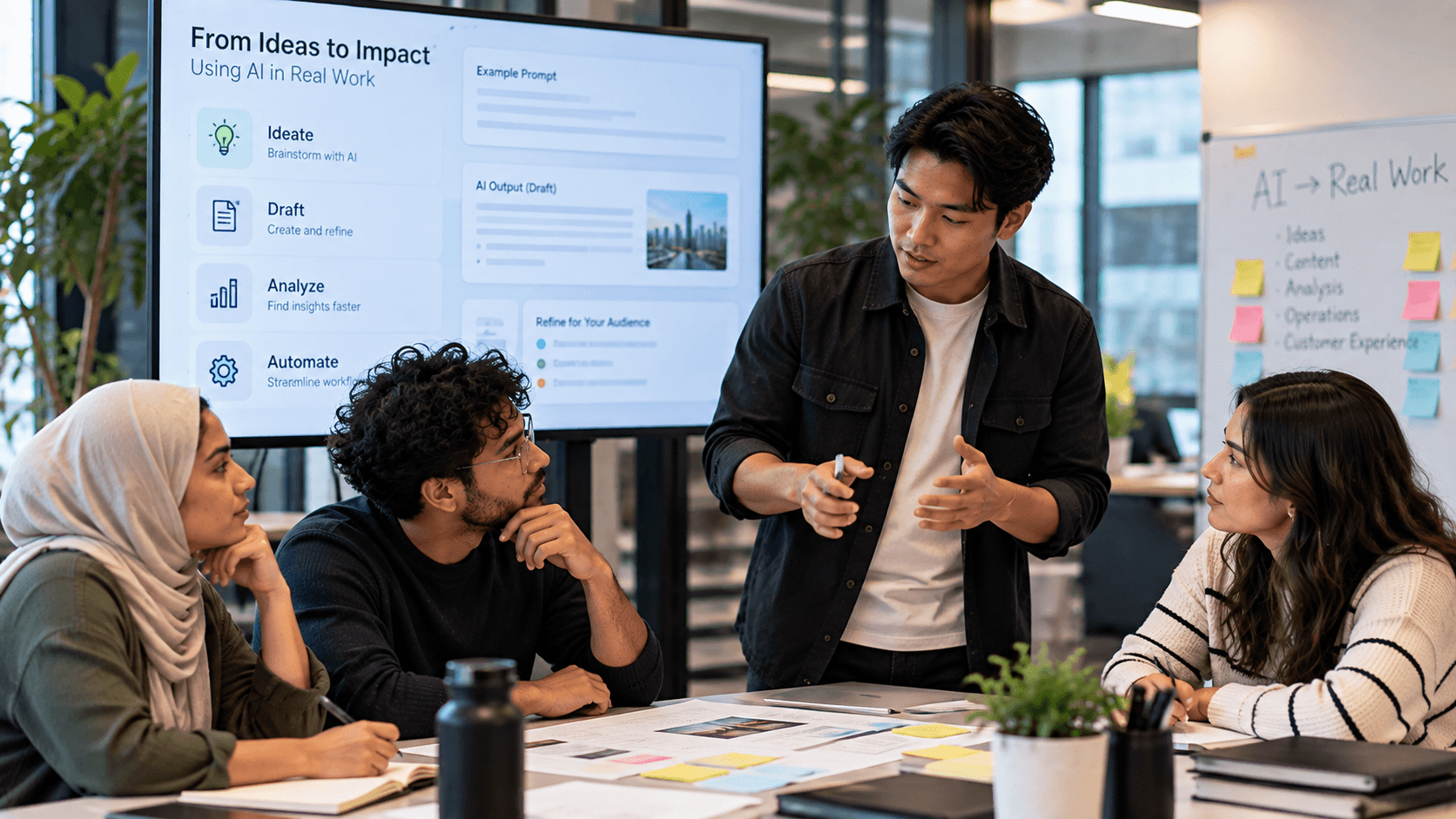
WorkFuture helps organizations build the skills people need to use AI effectively, critically, and responsibly at work.
Why AI Fluency Matters
As AI becomes part of how work gets done, organizations need more than access to tools. They need a shared understanding of what effective AI-enabled work looks like.
What We Mean by AI Fluency
AI fluency is the ability to work effectively, critically, and responsibly with AI to produce meaningful work.
It requires knowing what AI can do, collaborating with it effectively, evaluating what it produces, and maintaining human judgment and accountability.
The WorkFuture AI Fluency Framework™
AI fluency goes beyond tool familiarity. The WorkFuture framework defines it through four interconnected capabilities that can be developed, demonstrated, and assessed.
Understand AI's capabilities, limitations, risks, and appropriate uses.
Guide AI through context, questioning, feedback, and iteration.
Assess AI-generated work for accuracy, quality, relevance, and risk.
Turn human-AI collaboration into useful, meaningful work.
Protect Information · Recognize Risk · Maintain Human Oversight · Remain Accountable

From Framework to Work
AI fluency is not demonstrated by knowing the right terminology or using the latest tools. It shows up in how people apply AI to real work and the quality of what they produce.
What good looks like varies by role, responsibility, and context. The capabilities are shared, but the way they are applied should reflect the work.
The Questions Leaders Are Facing
Different roles and work require different applications of AI. Organizations need a shared standard that reflects their actual context.
Tool access and usage do not reveal whether people can apply judgment, collaborate effectively with AI, and produce strong work.
Organizations need to understand where capability is already strong and where development should be focused.
AI fluency develops through practice, application, feedback, and opportunities to demonstrate capability in real work.
How WorkFuture Helps
WorkFuture helps organizations move from a shared definition of AI fluency to demonstrated workforce capability.
Define what effective AI-enabled work looks like for the team, role, or function.
Understand what people can demonstrate today and where gaps exist.
Build capability through practical learning, applied exercises, and real work.
Track whether people are improving how they use, evaluate, and work with AI.
Start with one team, one function, or one workforce priority — then scale what works.
Discuss AI Fluency ProgramsSignature Workshops & Programs
WorkFuture's signature experiences turn the framework into practical learning that helps people understand, practice, and demonstrate stronger AI-enabled work.
Start Here
A practical 45-minute introduction to what AI fluency means, why it matters, and what effective AI-enabled work looks like.

AI Fluency Foundations
Build a shared understanding of effective, critical, and responsible AI collaboration.
AI Fluency Lab
Apply the framework through realistic AI-enabled scenarios that require collaboration, evaluation, judgment, and responsible decision-making.

Leading AI-Fluent Teams
Help managers set expectations, evaluate AI-assisted work, coach stronger practices, and maintain human judgment and accountability.
Start with a team session or one signature experience — then build a broader AI fluency initiative around your workforce.
Discuss AI Fluency ProgramsAdapted to Your People
The core competencies remain consistent, but AI fluency looks different depending on the work, responsibilities, and environment.

Workplace
Build the judgment and practical capability to use AI effectively in everyday work.
Management
Set expectations, evaluate AI-assisted work, coach stronger practices, and maintain accountability.
Education
Build AI fluency before entering an increasingly AI-enabled workforce.
Education
Use AI effectively while helping learners develop responsible and meaningful AI capabilities of their own.
Frequently Asked Questions
AI fluency is the ability to work confidently and responsibly with AI while applying sound judgment and critical evaluation.
AI literacy focuses on understanding AI concepts. AI fluency goes further by focusing on demonstrated capability—how people use AI to produce useful, responsible, high-quality work.
No. Prompting can be part of AI collaboration, but the framework also emphasizes understanding, iteration, evaluation, judgment, responsibility, and producing meaningful work.
Yes. The same framework can be adapted through role-specific expectations, scenarios, proficiency levels, and examples of what good AI-enabled work looks like.
Assessment can include scenario-based tasks, work simulations, demonstrated behaviors, self-reflection, and evaluation of how people guide, critique, and improve AI-assisted work.
Yes. Organizations can begin with a signature workshop or lab, then expand into assessment, custom curriculum, manager enablement, or a broader AI fluency initiative.
Yes. AI fluency can be adapted for students, educators, career centers, academic programs, and workforce partners preparing learners for AI-enabled work.
Yes. WorkFuture can help define what AI fluency means for your organization, establish capability expectations, assess current gaps, and design practical learning experiences.
Define what good looks like. Understand where your people are today. Build the capability they need to work effectively with AI.
Discuss Your AI Fluency Strategy